
Beyond Persuasive Prose: What Makes a Program Truly “Fundable”?
Summary:
In years past, securing funding followed a familiar formula: craft a compelling story about a community need, outline intervention activities, and submit the ask to funders with broad mission alignment.
For a long time, that approach worked.
Winning proposals ran on emotional appeal and persuasive prose, and funders relied on pre-defined social networks, general mission alignment, and self-reported headcounts.
But proposal evaluations have shifted. Today, funders invest in program viability, operational feasibility, and audit-ready execution frameworks. To meet these risk-managed priorities, reviewers skim past emotional appeals to hunt for robust program architecture (e.g., verifiable baselines, defensible logic models, and low-friction evaluation protocols).
If your program doesn’t explicitly showcase these elements, your application is cut, regardless of how moving your narrative is.
To secure the funding you need in this environment, your strategy must align with this reality: Writing is only 20% of the win. The other 80% is the strength of your program, designed before the first word is ever typed.
Below, we break down:
5 fundamental shifts: Why proposal evaluation transitioned from narrative-first to audit-ready.
8 core evaluation criteria: What benchmarks funders use to decide whether your program is truly fundable.
Key Takeaways:
Persuasive prose is a baseline, not a differentiator. Generative AI produces polished narratives in seconds. Reviewers skim your text and scrutinize your program blueprints: logic models, staffing ratios, hyper-local baseline data, and evaluation protocols.
Reviewers are risk managers. Under overhauled federal compliance rules, pass-through agencies and foundations are legally liable if subrecipients fail in the field. If your program execution doesn’t match your proposed plans, the funder shares the consequences.
Broad census data don’t prove competence. Generalized statistics establish geographic need; they don’t prove your team knows how to address it. Truly fundable programs isolate precise, local baselines that demonstrate deep knowledge and operational capability.
A schedule of activities isn’t a program model. Activities mean little without explicit causal links. Your program design must map tangible inputs to intermediate outcomes and systemic impacts without relying on assumptions.
Frontline workflows make or break awards (and service delivery). Promising massive reach without accurately modeling staff capacity is a clear warning sign of execution failure. Reviewers dissect staff-to-client ratios to make sure your team won’t burn out half-way through implementation.
Evaluation protocols can’t be retrofitted. Funders reject ambiguity. Winning submissions lay out concrete performance thresholds, credible verification sources, and simple data workflows that staff can manage without interrupting service delivery.
From Narrative-First to Audit-Ready: 5 Shifts in What Makes Programs “Fundable”
If your organization previously won awards through impassioned storytelling and poignant client spotlights, the success of that approach wasn’t an illusion. For a long time, philanthropy ran on relative capital abundance and looser reporting requirements.
That environment validated an informal traditional paradigm:
Emotive Appeal + Broad Census Need + Network Affinity = Funded Award
But continuing to rely on that traditional formula is a critical error. Five distinct shifts dismantled the success of that model.
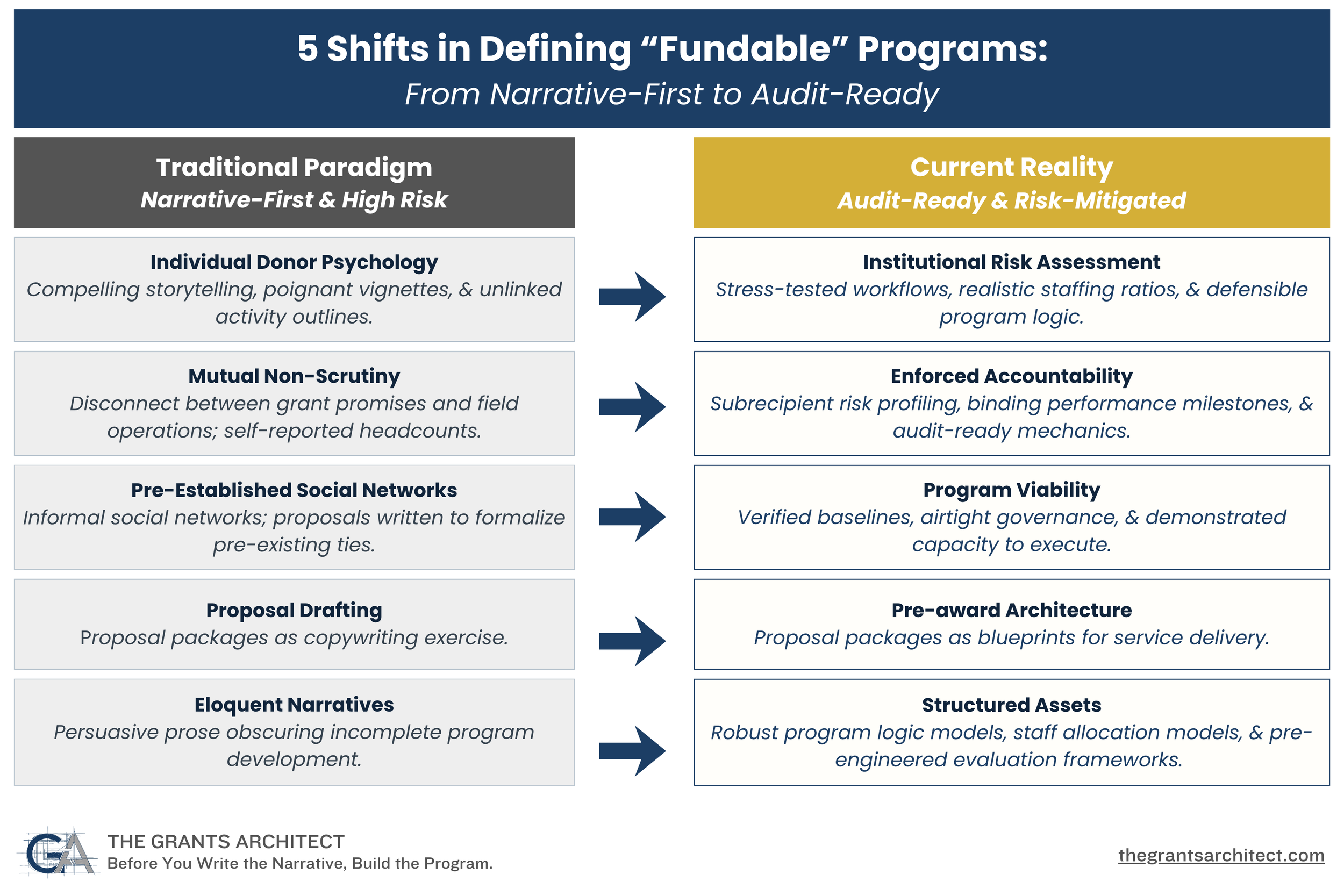
A comparative chart titled "5 Shifts in Defining Fundable Programs: From Narrative-First to Audit-Ready." The graphic contrasts traditional, narrative-first and high-risk program elements on the left with current, systems-first elements on the right. Arrows illustrate the transition from relying on individual donor psychology, mutual non-scrutiny, informal networks, copywriting, and eloquent narratives, to existing requirements of institutional risk assessment, enforced accountability, program viability, pre-award architecture, and structured assets.
Shift 01. From Individual Psychology to Institutional Risk
Individual donors respond to emotional connection. Behavioral economists call this dynamic the Identifiable Victim Effect (Jenni & Loewenstein, 1997; Small, Loewenstein, & Slovic, 2007). A single, named individual in acute distress consistently drives higher giving than “hard” data. In fact, introducing statistical evidence actually causes a drop in individual giving – a phenomenon known as compassion fade (Västfjäll et al., 2014).
Most development teams manage both annual appeals and institutional proposals under one departmental umbrella. Inevitably, fundraising strategies blended into grant development: describe the suffering, showcase organizational heart, list planned activities, and submit the ask.
Today, however, institutional grantmakers don’t operate on individual donor psychology. They act as capital allocators managing risk. Reviewers look past your stories to evaluate your program:
Does your program logic hold under close scrutiny?
Can frontline workflows manage target volume without breaking?
Does your staffing ratio prevent catastrophic burnout mid-cycle?
Shift 02. From Mutual Non-Scrutiny to Enforced Accountability
Traditional grantmaking allowed a quiet fiction: what was promised in the application was conceptually separate from post-award field operations. Before digital reporting tools, verifying field operations in real time was logistically impractical. Funders accepted high-level headcounts as public proof of success, leaving daily performance largely unexamined.
That lack of scrutiny proved costly, though. Fragile programs crumbled during implementation, community impact fell short, and ROI/ROM degraded.
That era ended with federal regulatory tightening. Revisions to the Uniform Guidance (2 CFR 200) codified subrecipient risk profiling (§ 200.331–.333), expanded unilateral termination authority (§ 200.340), and instituted mandatory performance milestones (§ 200.301).
Pass-through entities (e.g., local and regional government agencies, foundations regranting public funds) now face legal and financial penalties for partners' execution failures. If a program fails in the field today, the funder is on the hook for noncompliance.
Shift 03. From Pre-Established Social Networks to Program Viability
Historically, institutional funding followed personal networks, with proposals often serving to document and legitimize decisions already made informally.
Today, the sector has pushed back against this history with calls for Trust-Based Philanthropy (i.e., unrestricted, multi-year awards with minimal reporting). However, despite widespread public praise for flexible funding, actual funder behavior remains deeply risk-averse.
Persistent disconnects between funder rhetoric and practice mean that unrestricted dollars have become the most fiercely contested capital in the ecosystem (Buteau et al., 2020). Funders don’t award incomplete program designs with flexible capital; they reserve those awards for organizations with verified baseline data, airtight governance, and proven execution capacity.
More importantly, public capital doesn’t run on trust. Federal grantmaking runs on regulatory compliance. Betting your organization's sustainability on the hope of trust-based exemptions eliminates you from major public funding pipelines.
Shift 04. From Proposal Drafting to Pre-Award Architecture
Because review panels rarely explain why a proposal is denied funding, grant-seeking organizations often operate in an information vacuum. Without certainty about why they win or lose, organizations tend to follow the most visible surface traits of winning peers - a dynamic organizational sociologists call Institutional Isomorphism (DiMaggio and Powell,1983).
This dynamic birthed an entire cottage industry that approaches proposal packages as marketing copy rather than blueprints for service delivery. Organizations work to write their way to an award win, hiring grant writers to draft narratives before the underlying program is fully developed.
But while drafting a proposal is an administrative act, developing a program is an operational one. Even the most skilled grant writer can’t invent baseline metrics you haven’t captured, build staffing ratios you haven’t calculated, or fix missing program logic you haven’t modeled. Expecting them to do so relegates design gaps to copywriting problems.
Shift 05. From Eloquent Narratives to Structured Assets
Grant reviewers have always faced brutal constraints, evaluating dozens of technical applications in tight review cycles. In the past, a beautifully written narrative offered reviewers cognitive relief, which occasionally allowed eloquent prose to obscure incomplete program development.
Generative AI has inverted that reality. Review panels now face stacks of equally fluent, perfectly polished text. When every submission sounds articulate and impassioned, the competitive advantage eloquent writing evaporates. Excellent prose now serves as the delivery mechanism for rigorous structural assets, and if your program architecture isn’t sound, your proposal is eliminated immediately.
Exhausted reviewers skim your narrative and skip quickly to your structural assets:
Program logic models.
Baseline data tables.
Staff allocation models.
Evaluation frameworks.
Overall, fundability is no longer determined by how compellingly you describe a problem. Instead, a truly fundable program is audit-ready, risk-mitigated, and built to produce verified impact.
The Anatomy of a Truly Fundable Program: 8 Core Criteria
When reviewers score your proposal, they’re not grading an essay. They’re conducting a risk assessment.
If your program architecture is incomplete, persuasive writing will not conceal that void. Evaluators skim your narrative and focus on whether your program design can successfully deliver the outcomes you promise.
These eight criteria determine whether your program is built to win.
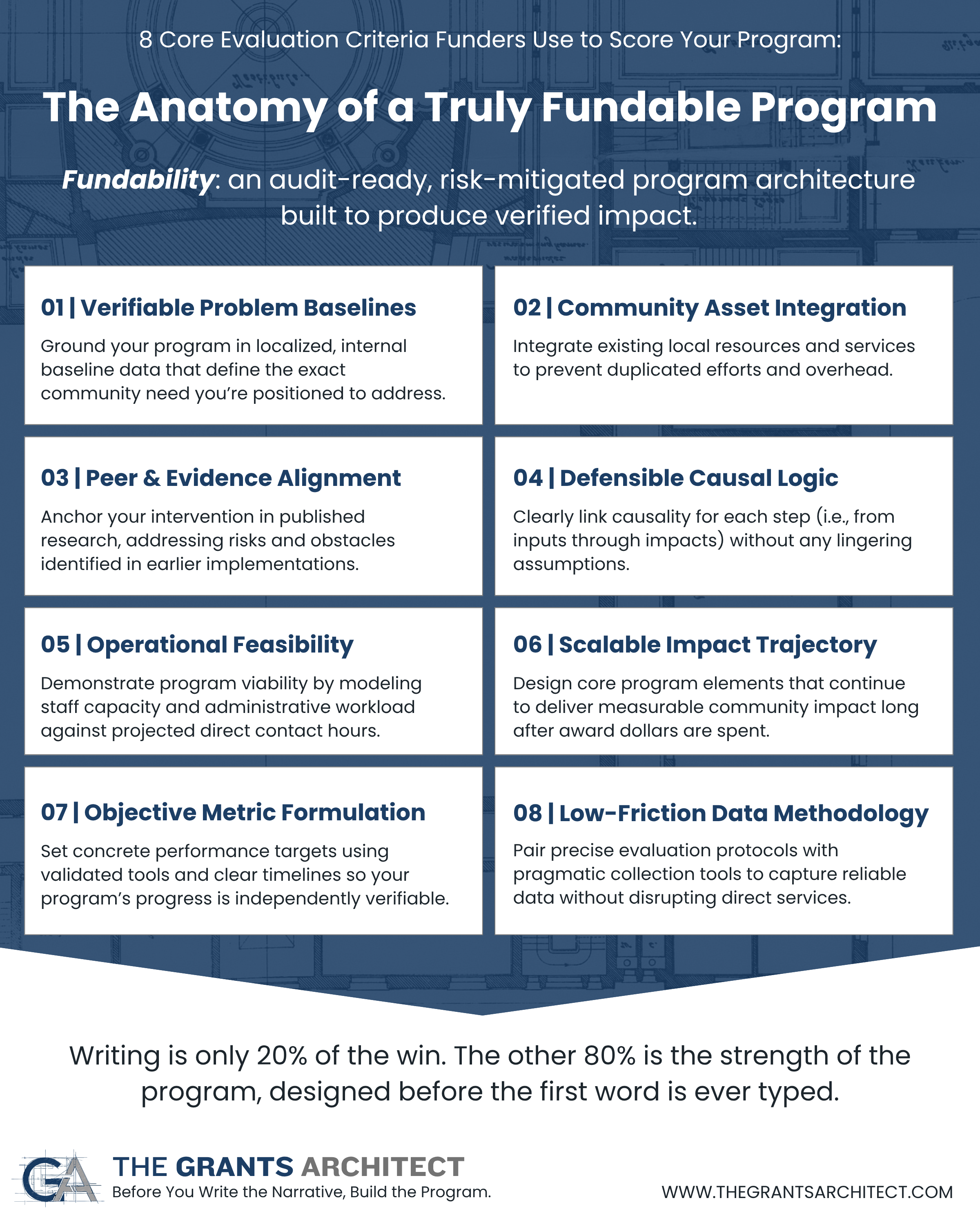
Image detailing the 8 core evaluation criteria funders use to determine program fundability. The graphic lists: 1. Verifiable Problem Baselines; 2. Community Asset Integration; 3. Peer & Evidence Alignment; 4. Defensible Causal Logic; 5. Operational Feasibility; 6. Scalable Impact Trajectory; 7. Objective Metric Formulation; and 8. Low-Friction Data Methodology.
Criterion 01. Verifiable Problem Baselines
Regional statistics alone cannot demonstrate your organizational capability. Stating that a metropolitan area has high rates of chronic absenteeism or housing insecurity shows broad geographic need, but it says nothing about your actual intervention for your specific target population. If your program isn’t grounded in localized, internal baseline data that define the exact community need you’re positioned to address, reviewers consider your program a high-risk investment.
Review panels look for localized baseline metrics isolating the precise problem your organization is positioned to address:
What are the baseline metrics of your target cohort before your services begin?
Where, specifically, do existing safety nets fail this population?
Does your baseline data prove that this group is falling through those gaps?
Criterion 02. Community Asset Integration
Proposing an initiative in a silo signals to reviewers that you’re not fully aware of existing resources in your ecosystem. Reviewers question whether your program will waste capital or alienate regional partners, and funders assume your post-award execution will stall against local resistance, service duplication, or unsustainable overhead.
If another organization is already addressing a component of the community need you intend to address, competing with them rather than collaborating with them makes your initiative an investment liability. Instead, integrate existing local resources and services to prevent duplicated efforts and overhead.
Reviewers actively down-score applicants who position themselves as lone actors:
Which existing community resources are formally integrated into your service pipeline?
At what point does your team transition clients to existing peer providers?
How, specifically, does your model prevent duplicating administrative costs across the local ecosystem?
Criterion 03. Peer & Evidence Alignment
Funders invest in viable interventions with high likelihood of meaningful outcomes, so your program must be grounded in established precedent. If your program isn’t designed around validated evidence, you’re asking a funder to finance a very expensive experiment. Anchor your intervention in published research and tested peer models, addressing risks and obstacles identified in earlier implementations.
Evaluators are looking for evidence-based interventions:
What validated peer models or published research support your proposed intervention?
If you’re adapting an evidence-based framework, what intentional modifications have you made for your target demographic?
How does your delivery plan address failure points identified in earlier implementations?
Criterion 04. Defensible Causal Logic
A calendar of planned activities isn’t a program model. Funders invest in unbroken causal chains: tangible inputs that drive targeted activities, which yield direct outputs, which produce measurable progress and culminating in lasting impacts. When the causality or logic between an activity and an outcome isn’t explicit, reviewers question whether you have the mechanisms in place to deliver the change you promise. Clearly link causality between each step of your program (i.e., from inputs through impacts) without any lingering assumptions.
If a reviewer asks why Activity B leads to Outcome D, your program logic must answer for itself without assumptions:
If you strip your narrative away entirely, does your program logic stand on its own?
Have you clearly articulated mechanisms of change, or have you (inadvertently) skipped steps?
What unstated assumptions are you treating as guaranteed outcomes?
Criterion 05. Operational Feasibility
Frontline burnout is a critical compliance risk. Promising an ambitious reach without clearly demonstrating operational feasibility is a primary indicator of post-award program collapse. To make sure they’re investing in programs that will succeed during implementation, funders examine staffing ratios and overhead allocations. Demonstrate your program’s feasibility by accurately modeling staff capacity and administrative workload against projected direct contact hours.
Reviewers assess your capacity thresholds:
Do your staff hours balance against your projected client contact time?
Will frontline workloads trigger catastrophic staff turnover halfway through implementation?
Does your budget account for the true cost of supervision, compliance, and record-keeping?
Criterion 06. Scalable Impact Trajectory
Funders view grants as seed capital, not perpetual life support. They don’t fund interventions that evaporate as soon as award funds are spent but instead prioritize enduring organizational and community resilience. Design core program elements that continue to deliver measurable community impact long after award dollars are spent.
Reviewers evaluate the post-award horizon:
Does your initiative build lasting community resources, or does it just fund temporary services?
How does your program generate sustained operational efficiencies over time?
What cross-sector infrastructure or institutional assets remain functional after the award period ends?
Criterion 07. Objective Metric Formulation
Subjective goals (e.g., "enhancing participant resilience" or "increasing community awareness") lower technical review scores. Ambiguous metrics signal that you haven’t precisely defined what short-, intermediate-, and long-term operational success looks like, or that your organization lacks the capacity to verify the impact your program does produce. Set concrete performance targets using validated tools and clear timelines so your program’s progress and success are independently verifiable.
Evaluators expect objective performance indicators:
Are your outcomes defined by clear thresholds, percentages, and timeframes?
What external tools or validated instruments are you using to prove you hit those targets?
Would those metrics hold up to a federal audit without subjective interpretation?
Criterion 08. Low-Friction Data Methodology
Highly competitive submissions are precise: who collects which points of data, with what instrument, how often, and where is that data tracked. With this level of detail funders are confident they’re protecting their investment and satisfying their legal responsibilities. Pair precise evaluation protocols with pragmatic collection tools to capture reliable data without disrupting service delivery.
Reviewers assess not only what data you intend to capture but also how they get collected in the field:
Does your data collection process pull staff away from direct services?
Are your collection protocols integrated into daily workflows, or piled on top as extra paperwork?
Does client data collection meet compliance standards without degrading participant trust?
When your organization masters these core criteria, your proposal narrative simply documents an operational architecture that is viable, defensible, and ready to execute.
Strategic Priorities for Your Next Funding Pursuits
Entering late 2026 and positioning for 2027, the funding landscape has settled into a risk-averse, audit-first environment. Positioning your organization to secure the funding you need requires a shift in strategy:
Retire the narrative-first approach. Grant writers are critical assets for translating complete programs into clear proposals, but hiring them to draft a narrative around an incomplete program design guarantees frustration and likely leads to funding denials. The writer has to invent program design on the fly, producing vague promises that trigger submission rejections or cause execution breakdowns later.
Front-load pre-award program architecture. Before writing your narrative, invest your time and energy where evaluation points are actually won: establish your baselines, map local resources, stress-test your logic, verify staff capacity, and finalize your data collection workflows.
Approach funders as investment partners. Funders are allocating risk-managed capital. Show them an audit-ready program blueprint that demonstrates verified capacity, defensible logic, and clear accountability.
When you build a robust program first, the proposal narrative writes itself. More importantly, your case for funding support becomes undeniable.
Program Fundability Diagnostic Tool
Before committing time, budget, and staff capacity to drafting your next narrative, stress-test your program’s fundability.
This diagnostic tool reflects the real-world scrutiny reviewers and funders use when they’re deciding which proposals to award. Score your program, in its current state, across each criterion to identify where your design is fundable and where remaining ambiguities risk a denial.
Scoring Key
0 | Not Started: You have ideas about how to approach this criterion but haven’t begun operationalizing it yet.
1 | In Progress: You’ve started the work, but you’re still finalizing key elements (e.g., mechanics, data, capacity thresholds).
2 | Audit-Ready: This criterion is fully architected, empirically grounded, and defensible under rigorous review.
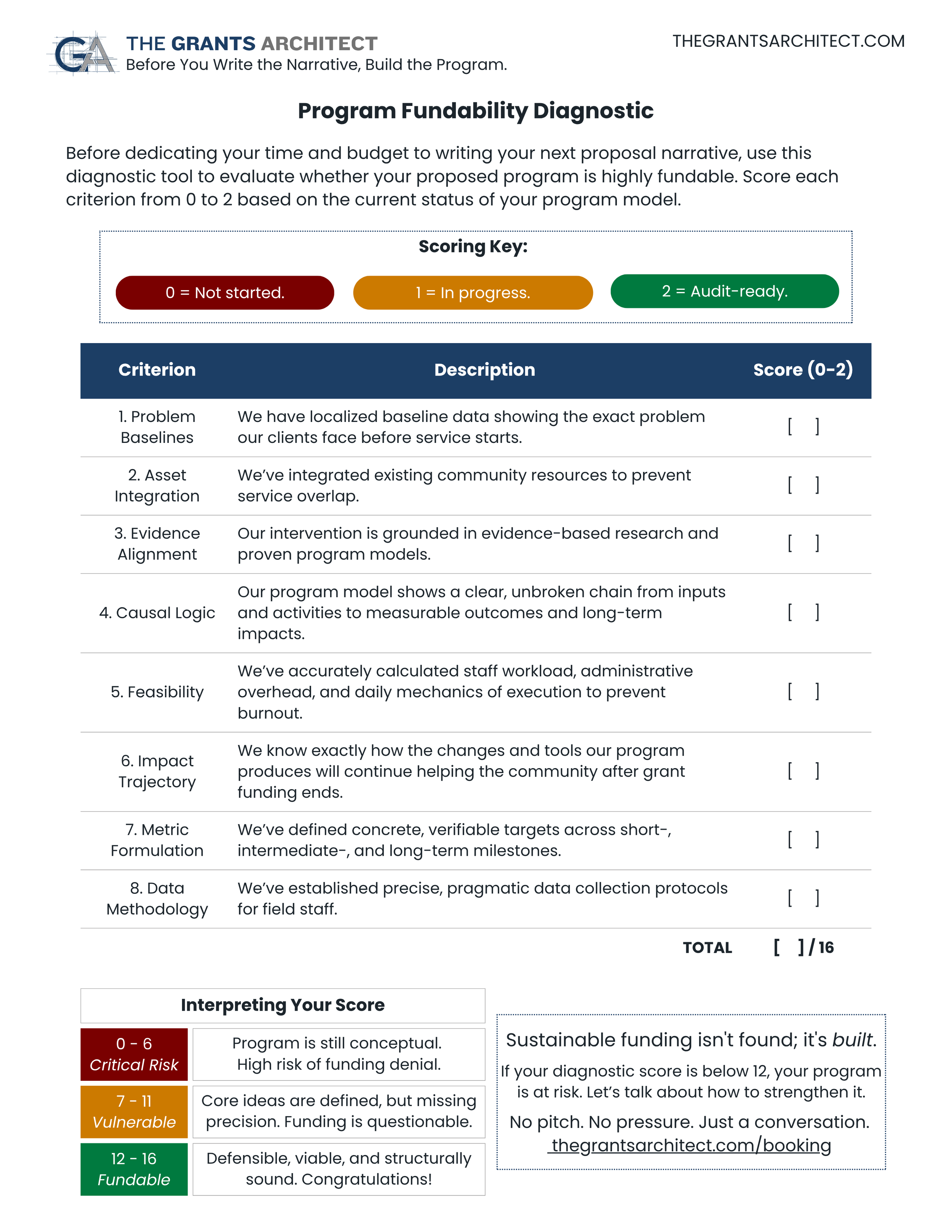
A self-assessment rubric titled "Program Fundability Diagnostic." The tool provides a scoring key where 0 is "Not started," 1 is "In progress," and 2 is "Audit-ready." It lists the 8 core criteria with checkboxes for users to calculate a total score out of 16. A color-coded interpretation key at the bottom explains the results: 0-6 indicates Critical Risk (Program is still conceptual); 7-11 indicates Vulnerable (Core ideas defined, but missing precision); and 12-16 indicates Fundable (Defensible, viable, and structurally sound).
Let’s Talk About Your Program.
If your diagnostic score shows vulnerabilities in your program’s design, persuasive writing alone won’t fix them.
The Grants Architect partners with cross-sector coalitions, public agencies, and established non-profits to translate great ideas into highly fundable program blueprints that secure funding and simplify implementation. We develop your research baselines, program logic model, and evaluation protocols before your team starts writing.
Schedule a no-pitch, no-pressure conversation at: thegrantsarchitect.com/booking.
