
Deconstructing the Myth of the 3-Phase Grant Lifecycle
Summary:
Many mission-based organizations rely on the traditional 3-phase grant model (Pre-Award, Award, Post-Award) to manage internal operations. However, this framework was designed for federal funder compliance, not recipient execution. Using a linear compliance tool as an internal operational strategy creates a critical liability. It forces organizations into reactive grant-seeking, generates post-award operational panic, and erodes funder trust in an increasingly competitive funding landscape.
To achieve long-term funding sustainability, organizations must adopt an internal operational framework that reflects the cyclical reality of grant work. The Grants Architect’s 5-Phase Grant Lifecycle, spanning Foundation, Pre-Award, Award, Post-Award, and Calibration phases, bridges the gap between funder compliance and real-world execution. By establishing pre-proposal data strategies, co-designing programs with upstream community partners, and looping post-award learning into future designs, this closed-loop model drives asset accumulation and compounds your organizational capacity.
Key Takeaways:
Symptoms: Rushed proposal submissions, burned-out staff, a pattern of grant denials, and post-award execution panic when an award is secured.
Problem: Mission-based organizations use the compliance-focused 3-phase grant lifecycle as their internal grant strategy, overlooking the cyclical reality of grant management.
Impact: The 3-phase model creates an illusion of readiness, leads to reactive grant-seeking, triggers administrative chaos, and ultimately undermines funder confidence.
Solution: Transition to a 5-Phase Grant Lifecycle (Foundation, Pre-Award, Award, Post-Award, Calibration) that aligns internal operations with real-world execution to build sustainable funding.
Why the 3-Phase Model Fails
The traditional 3-phase grant lifecycle (i.e., Pre-Award, Award, Post-Award) was developed to support federal agency oversight, compliance, and governance – not the operational realities of awardees. Relying on this compliance framework as an internal operational strategy is a critical liability, because it overlooks the cyclical reality of grant work.
The grant lifecycle doesn't simply start when an opportunity is posted and end when a close-out report is submitted. Instead, grants work is fundamentally recursive, with the outputs from one grant driving success in the next. True competitiveness, then, requires robust program designs, fully articulated long before a solicitation drops, with data-driven outcomes directly fused into subsequent proposals.
Compounding this challenge, macroeconomic shifts have flooded non-governmental grantmakers with applications, forcing them to adopt evaluation standards historically reserved for federal compliance. As the entire funding ecosystem tightens, relying on a linear compliance model is no longer just inefficient. It’s perilous.
Traditional 3-Phase Lifecycle: A Compliance-Focused Linear Model
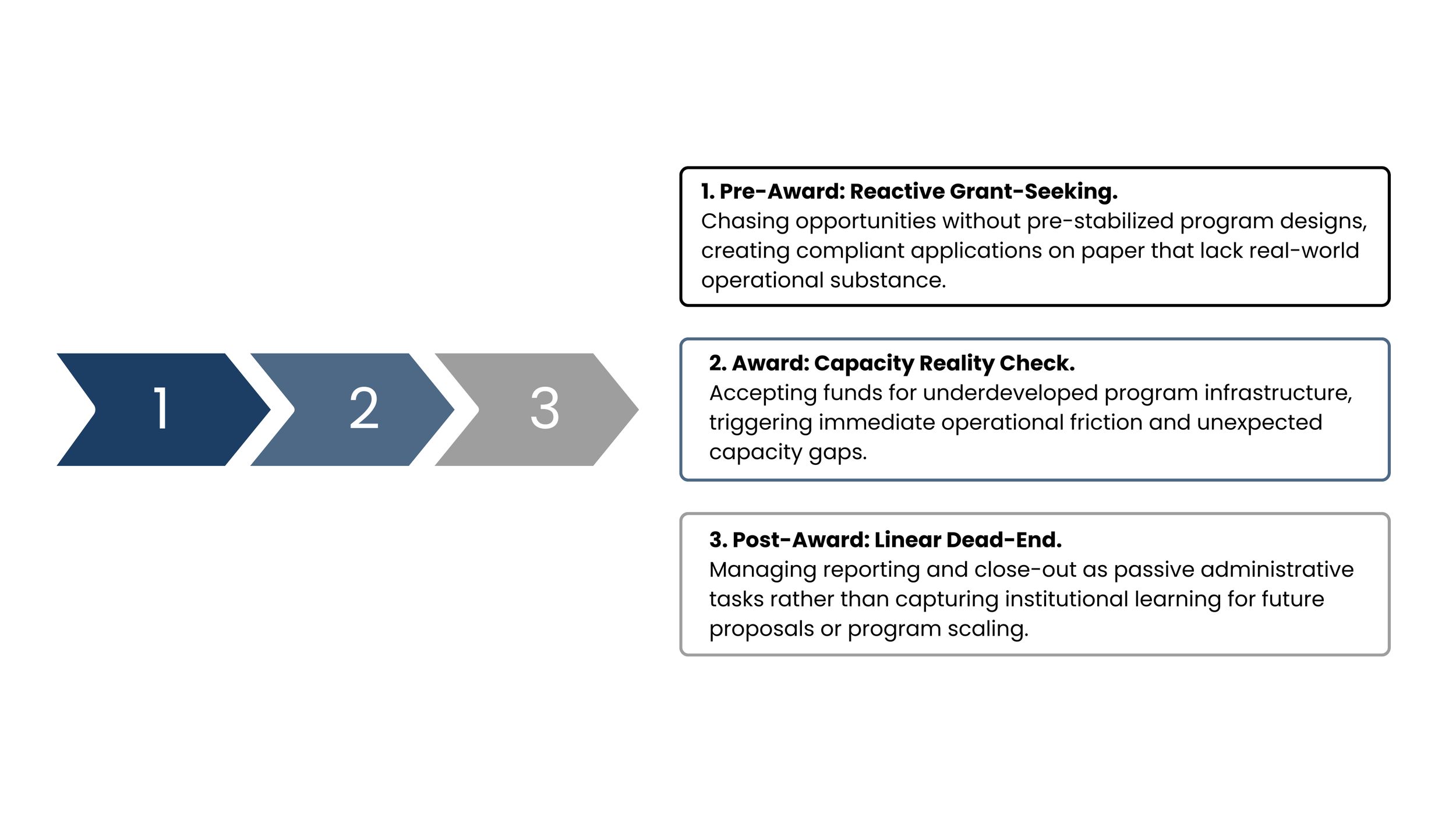
Diagram illustrating the Traditional 3-Phase Grant Lifecycle: a linear chevron sequence on the left numbered 1 through 3 in navy, slate, and gray tones. To the right, three stacked rounded callout cards outline the failure points of the compliance-focused paradigm: 1. Pre-Award (Reactive Grant-Seeking), 2. Award (The Capacity Reality Check), and 3. Post-Award (Linear Dead-End Burden).
Problem: Predictable Consequences of the 3-Phase Grant Lifecycle
Relying on the traditional 3-phase lifecycle model inevitably triggers a domino effect of operational chaos, strained resources, and eroded trust.
Here are three of the most common consequences we see:
Illusion of Readiness: Treating submission tools (like logic models) as administrative checkboxes rather than operational blueprints creates compliant applications on paper, but post-award implementation and reporting nightmares in practice.
Reactive Grant-Seeking: Chasing marginally aligned grants without pre-stabilized program designs strains internal capacity, produces uncompetitive applications, and triggers denial cycles that damage funder relationships.
Post-Award Administrative Panic: Winning an award without a fully developed program design creates an immediate operational crisis, forcing staff to retroactively build essential program infrastructure under intense pressure.
Outcomes like these ultimately undermine funder trust. Grantmakers are ROI-focused investors who expect clear proof of impact – not the operational friction of salvaging underdeveloped program infrastructure.
Solution: Building Sustainability Through a Comprehensive Model
Overcoming these operational liabilities requires an internal operational strategy that reflects how grants actually work. Designed explicitly for mission-based organizations, The Grants Architect’s 5-Phase Grant Lifecycle bridges the gap between funder compliance and real-world execution, providing a practical roadmap for sustainable funding.
The Grants Architect’s 5-Phase Lifecycle: A Closed-Loop System for Compounding Capacity
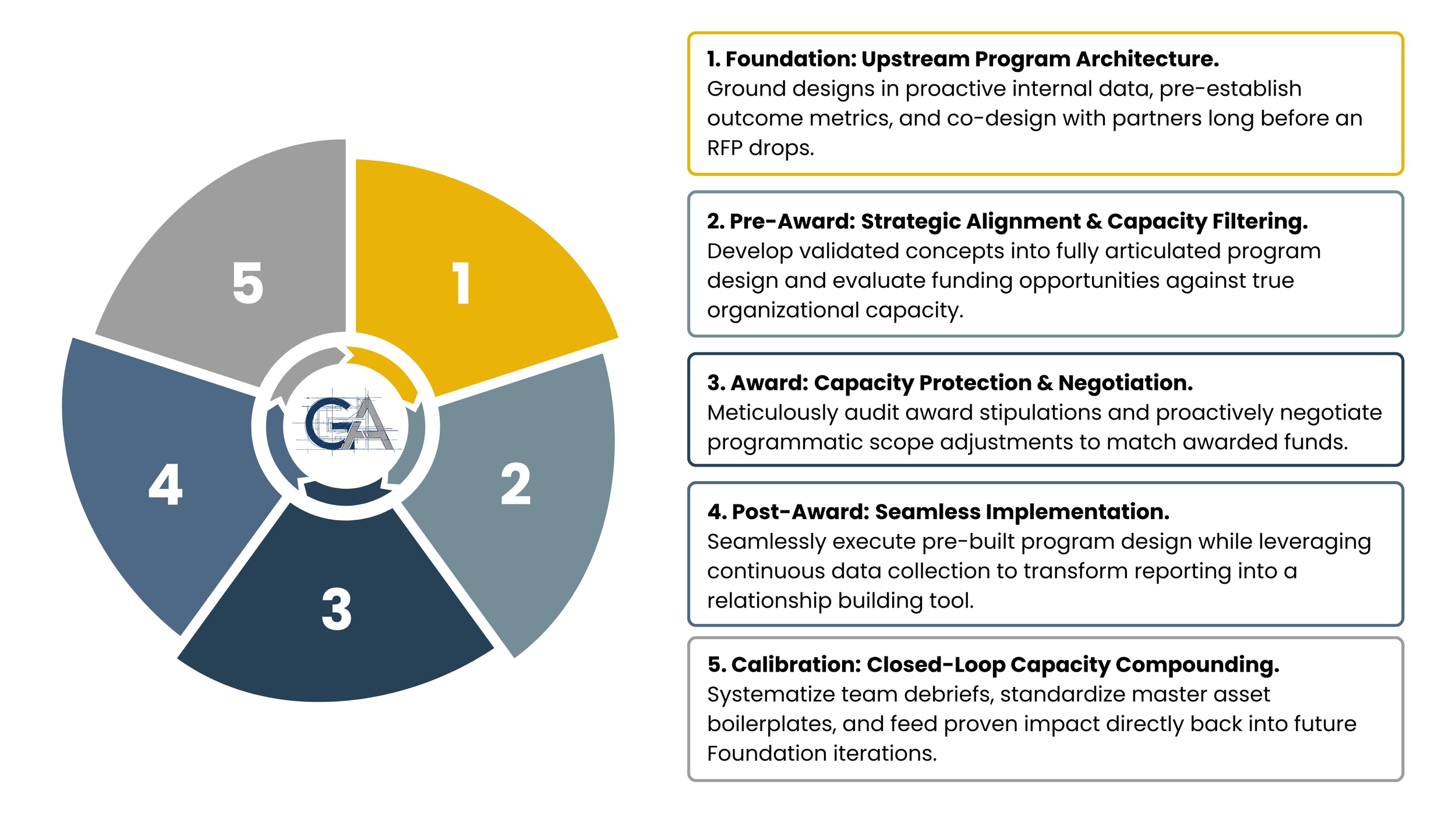
Diagram illustrating The Grants Architect 5-Phase Grant Lifecycle: a circular closed-loop flywheel on the left containing five numbered segments—Foundation, Pre-Award, Award, Post-Award, and Calibration—with the GA logo at the center. To the right, five stacked, color-coded callout boxes detail each phase’s strategic focus: Upstream Program Architecture, Strategic Alignment & Capacity Filtering, Capacity Protection & Negotiation, Funder Stewardship Engine, and Closed-Loop Capacity Compounding.
Phase 1: Foundation (Laying the Groundwork)
The foundation of any successful application is an internally validated, data-driven program design supported by pre-established community partnerships.
Step 1: Generate fundable program concepts. Ground program design in proactive internal data, validate the problem’s scale through external research, and evaluate concepts against an explicit Theory of Change and operational feasibility rubric.
Step 2: Establish proactive data strategy. Establish baseline indicators and outcome metrics before an RFP drops, turning continuous data collection into a permanent asset that demonstrates investment readiness.
Step 3: Substantiate partner support. Socialize validated program concepts early to co-design initiatives, securing substantive MOUs and active co-investors well ahead of active application windows.
Phase 2: Pre-Award (Planning & Applying)
With foundational data and partnerships established, this phase turns strategy into action through proactive program design and detailed proposal development.
Step 1: Design fully articulated program. Build out a complete program logic model, not just as a required proposal attachment, but as the actionable operational blueprint for execution so post-award teams don't have to scramble to assign roles or track metrics.
Step 2: Assess organizational capacity. Evaluate internal capabilities, including finance, HR, and IT infrastructure, to confirm the organization can sustain the program before applying.
Step 3: Identify best-fit opportunities. Screen the funding landscape against realistic success probabilities, eliminating wasted internal bandwidth on misaligned prospects.
Step 4: Prepare and submit proposal. Craft customized narratives tailored to funder priorities and assemble the complete application packet without the stress of last-minute document gathering.
Phase 3: Award (Negotiation & Program Initiation)
The award phase is a critical period of operational transition, moving program design into active execution.
Step 1: Review award with funder. Meticulously audit the specific terms, conditions, and compliance stipulations embedded in the Notice of Award.
Step 2: Negotiate terms. Proactively negotiate a corresponding reduction in programmatic scope if the funder awards less than the requested budget.
Step 3: Execute formal acceptance. Sign binding documents and immediately activate internal infrastructure, including restricted account codes and tracking procedures.
Phase 4: Post-Award (Doing the Work & Reporting)
In our comprehensive model, the post-award phase is managed as active funder stewardship rather than passive administrative burden.
Step 1: Execute and evaluate program. Implement program operations as designed, maintaining rigorous spend-down tracking and continuous mixed-methods data collection on participant outcomes.
Step 2: Leverage reporting for stewardship. Transform interim and final reports into relationship-building tools, sharing transparent updates and compelling impact stories to position your organization as a trusted partner.
Phase 5: Calibration (Learning & Looping Back)
Iteration transforms grant management from a linear sequence into a sustainable, closed-loop system that continuously elevates future submissions.
Step 1: Conduct team debriefs. Evaluate post-implementation staff capacity, burnout levels, and operational friction points to safeguard retention and inform future program architecture.
Step 2: Systematize program improvements. Analyze post-award outcomes and challenges to actively feed programmatic learning back into organizational strategic planning.
Step 3: Standardize core boilerplates. Distill refined program models, evaluation methods, and line-item budgets into master boilerplates to accelerate subsequent proposal development.
Step 4: Return to Foundation and repeat. Leverage completed grant success stories as primary marketing assets to secure multi-year renewals or attract higher-tier investments, looping back into Foundation with elevated readiness.
Conclusion: Building Your Closed-Loop System
A grant isn’t just a single funding event; it’s an organizational asset that requires a system capable of sustaining it. The traditional 3-phase lifecycle presents grants linearly, with a definitive beginning and end. But starting your grant work only when an RFP drops creates an illusion of readiness. Your program might look complete on paper, but behind the scenes, your post-award team is left rushing to retroactively assign roles, piece together execution, and collect data for an underdeveloped program. Plus, after final close-out, your program successes aren’t carried through to your next proposal, trapping your organization in a reactive cycle of grant-seeking and administrative scrambling.
Real institutional sustainability requires a strong foundation, a fully articulated program design, and a closed-loop approach. By building robust program designs in Phase 2 (Pre-Award), using a complete logic model as your operational blueprint rather than a superfluous application attachment, you set up your post-award teams for effortless execution. And by connecting Phase 5 (Calibration) back into Phase 1 (Foundation), you turn grant management from a compliance burden into a comprehensive system for compounding both your capacity and your institutional assets.
Next Steps
Evaluate Your Approach: Download our 12-Point Grant Program Diagnostic to assess the strength of your current grants approach.
Download the Diagnostic Tool
Ready for a Full-Cycle Strategy? If your team is ready to transition from a compliance-focused framework to a capacity-building, closed-loop system, let's spend 30 minutes reviewing your grant architecture together.
