
Summary:
Most organizations plan their grant work around three phases: Pre-Award, Award, and Post-Award. That model comes from the federal grant process; it starts when a funder posts an opportunity and ends at closeout.
In reality, the grant lifecycle starts before a funding announcement and doesn't truly end. Planning for that full lifecycle shifts program design ahead of the posting. As a result, applications can come together faster and compete better, and your team starts the award with a plan it can follow. After closeout, each grant's results and lessons also feed back into future planning, so your next proposal starts from evidence instead of from scratch.
That shift matters more now that competition for foundation and corporate funding has intensified. This article presents a 5-phase lifecycle that adds Groundwork at the start and Calibration at the end. Together, they turn a truncated, linear process into a cycle that reflects how grants function in practice.
Built for agencies, not applicants.
Grants.gov describes federal grants as following a linear lifecycle in three phases (Pre-Award, Award, and Post-Award) and lays out what the funding agency and the applicant each do along the way. The model is agency-driven by design, meant to help applicants work smoothly with the agencies that fund them, and for that purpose it is accurate. It was not, however, built as an internal plan for developing and running programs, even though the field now widely treats it as the grant lifecycle.
Used as an internal plan, the 3-phase model leaves two gaps. Because it begins when a funding announcement is posted, it has no place for what competitive proposals depend on, such as a tested program concept, baseline data, and committed partners. And because it ends at closeout, it has no step for carrying one grant's results into the next proposal, even though those results are often the strongest evidence an organization has.
Recent shifts in funding have made both gaps more costly. In a 2025 GrantStation survey, 30.4% of organizations reported reduced or canceled federal awards, and 76.5% of organizations adapting to those changes sent more applications to private foundations or corporations. Because federal funding has typically gone to larger organizations with more internal resources, many of these applicants are accustomed to federal-level competition, with proposals developed to match.
Meanwhile, 87% of foundation leaders surveyed by the Center for Effective Philanthropy reported increased demand for funding in 2025. Foundations and corporate funders are therefore weighing federal-caliber proposals alongside applications from organizations that have never needed that level of preparation, and when funds are limited, the more fully developed proposal is more likely to prevail.
The organizations most affected by this shift are those with the fewest resources to adapt. Organizations with experienced grants staff often already plan beyond the three federal phases. Smaller nonprofits and coalitions, by contrast, generally rely on the guidance most readily available, including the 3-phase model as it is widely taught. Following that model, they reach each deadline without the groundwork their competitors have already done and begin each new grant without fully drawing on the last. Consequently, their awards become harder to win and harder to sustain.
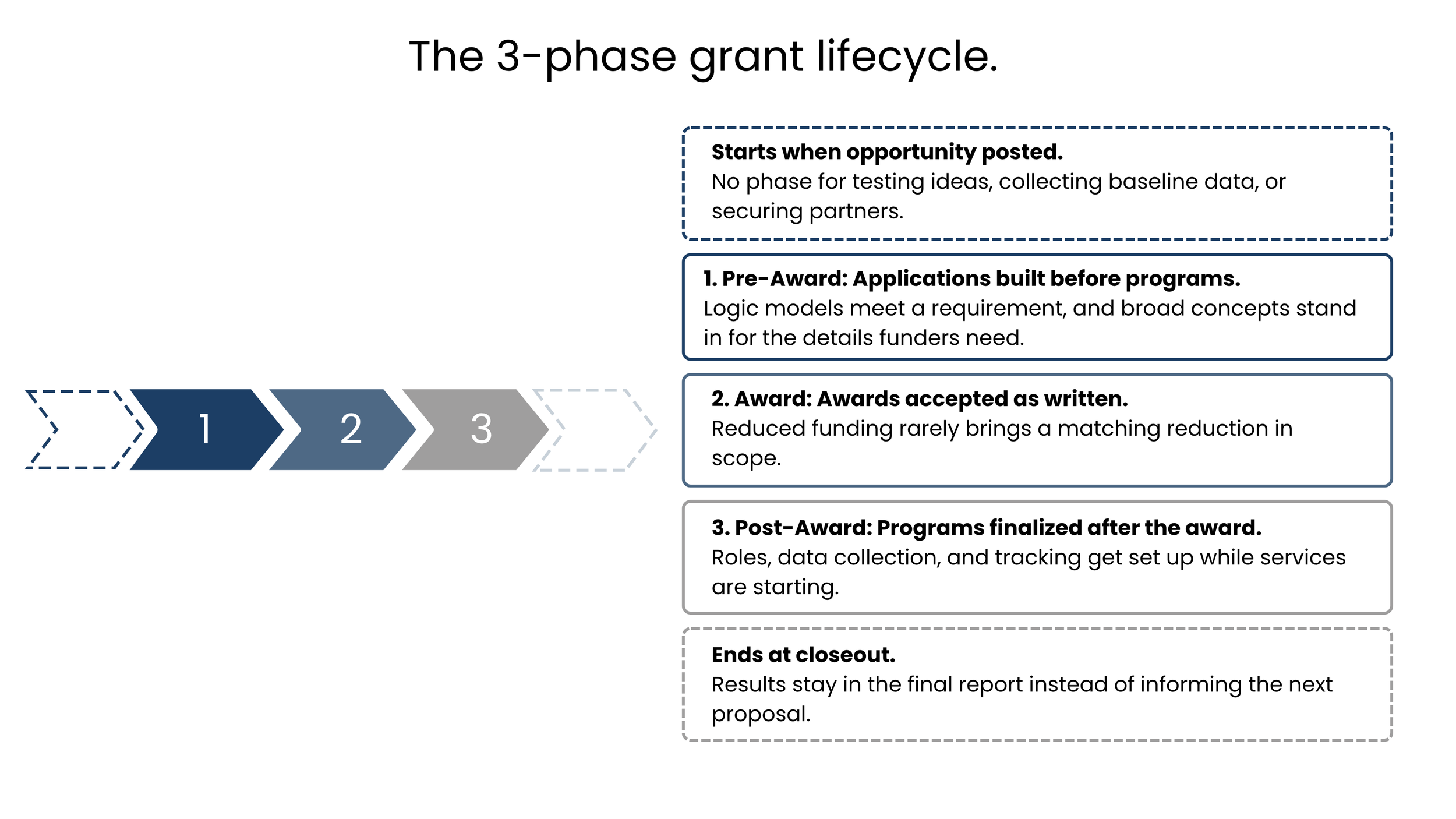
How the gaps show up in practice.
If your organization plans its grants around the 3-phase model, three patterns commonly follow. None of them reflects poor effort. Rather, each grows out of short funding timelines and small teams doing their best within a model that leaves the most important tasks unscheduled.
Logic models built for the application.
Because many funders require a logic model, yours may get built in the final weeks before a deadline, primarily to satisfy the application. The proposal looks complete, but the logic model hasn't defined who does what, when, or how results will be measured. Those questions then resurface after the award, when your staff are already delivering services and have the least time to answer them. A logic model built as the program's working plan, by contrast, defines these details before the application is submitted.
Concepts submitted as programs.
When program planning starts with the solicitation posting, there's rarely time to test a new idea before the deadline. Instead, your team may design a conceptual program to fit the opportunity. The resulting application describes broad concepts rather than precise details (who delivers what, to whom, and how success will be measured) that give funders confidence in a program's viability and feasibility. Without that confidence, funders are less likely to invest. A program designed and tested in advance reverses that dynamic, because its details are already in place when the solicitation drops, so your application can show funders exactly how the program will run.
Programs finalized after the award.
Without a detailed program design, the first months after an award are focused on establishing roles, data collection protocols, and tracking systems. That effort strains staff and can delay both services and reporting, just as the funder is forming its first impression of you as a new grantee. However, when those specifics are resolved during design, your team can start the grant period with service delivery.
A 5-phase lifecycle built for applicants.
The Grants Architect's 5-phase lifecycle retains the three federal phases, so it stays compatible with how funders manage awards. It also adds a phase at each end to capture what goes into developing and sustaining competitive programs in practice. Groundwork precedes any funding announcement, and Calibration follows closeout and loops back to Groundwork, so each grant strengthens the next. Just as important, the model reworks the middle three phases from the applicant's side, so each one builds on the design work that came before it. This 5-phase model changes more than a visual diagram, though. It moves your most involved program decisions to a point in the lifecycle when there's time to make them carefully, rather than into the weeks before a deadline or the months after an award.
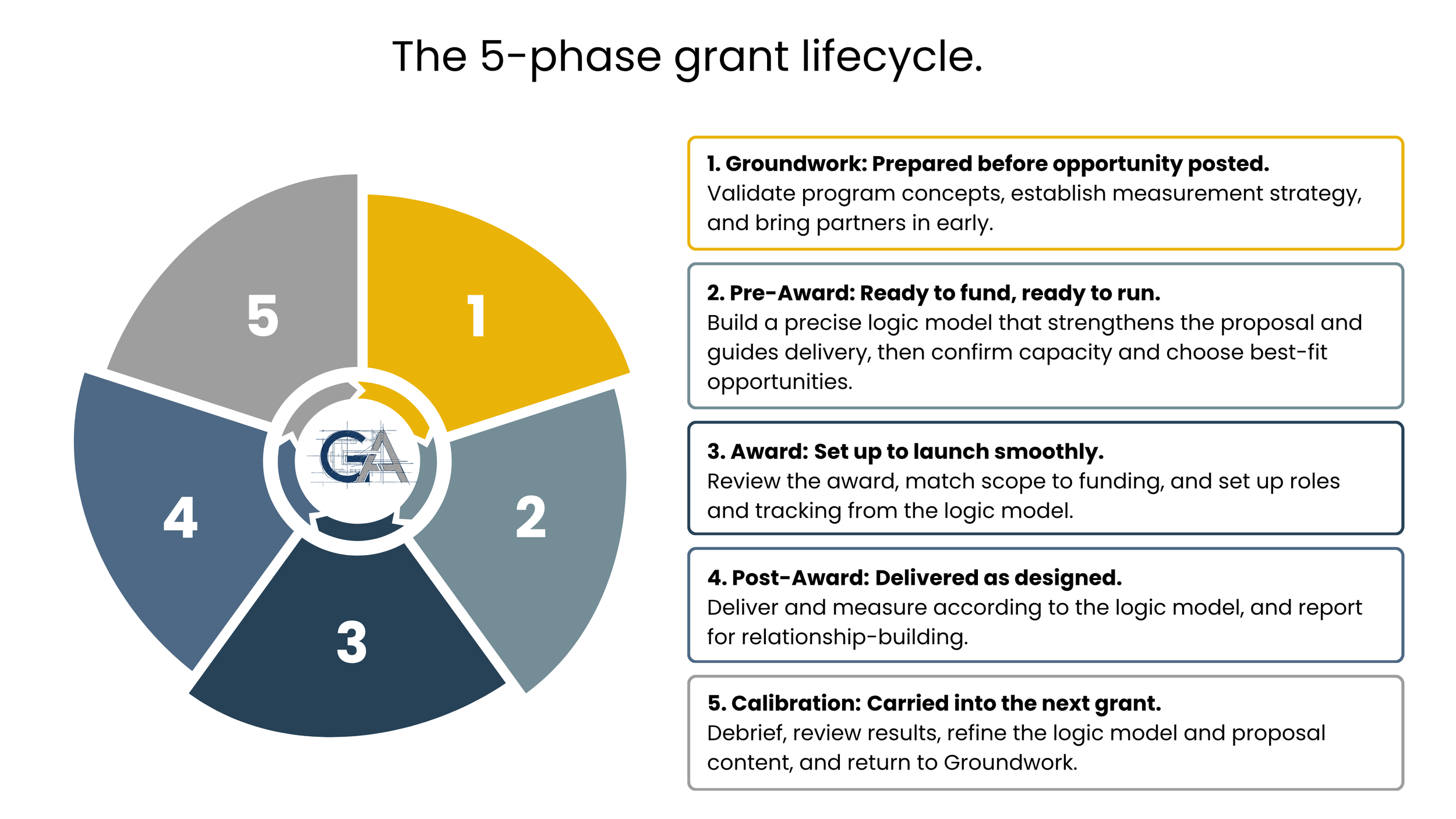
Phase 1: Groundwork
The Groundwork phase centers on tasks that don't depend on a funding deadline. While the 3-phase model leaves them out, since they fall outside any single solicitation's timeline, without these early steps integrated into your grants strategy, your grants work is often more difficult and less successful.
Test the program concept. Start with the data you already collect and check the scale of the need against published research. Then weigh the idea against a theory of change and what it would take to run.
Establish program measurement. Set baseline indicators and outcome measures before any deadline, so the data you collect all along becomes evidence for any proposal.
Bring partners in early. Share the tested concept, design the program together, and formalize commitments well before an application window opens.
Phase 2: Pre-Award
With the groundwork in place, the Pre-Award phase turns a validated concept into a complete program design and, from that design, a competitive proposal.
Build the logic model to run the program. Treat it as the plan you'll implement, not just a required attachment, numbering each activity and carrying it through the evaluation plan, implementation timeline, and budget.
Confirm your capacity. Make sure your finance, HR, and IT teams and systems can support the program.
Choose best-fit opportunities. Apply where the program fits and you have a realistic chance of winning, since passing on poor matches saves staff time for the applications that count.
Tailor the narrative. Because the program is already fully developed, the focus shifts to presenting it in each funder's terms rather than building it against a deadline.
Phase 3: Award
The Award phase moves the program from plan to delivery, and the decisions made here shape how smoothly that transition goes.
Review the award closely. Read the Notice of Award (or award letter) for its terms, conditions, and reporting requirements.
Match scope to funding. If the award is smaller than your requested budget, negotiate a corresponding reduction in scope.
Set up for launch. Accept the award and put in place what the program needs to begin, following your well-defined logic model.
Phase 4: Post-Award
In the Post-Award phase, reporting becomes part of an ongoing relationship with the funder rather than a compliance requirement alone.
Deliver the program as awarded. Track spending against the budget, and collect mixed-methods outcome data throughout (both numbers and participants' own accounts).
Report for relationship-building. Use interim and final reports to keep the funder informed, with candid updates on progress and stories of what changed for participants.
Phase 5: Calibration
Calibration is what turns the lifecycle into a loop. Without it, your hardest-won lessons stay buried in a final report; with it, they become the starting point for your next grant.
Debrief with your team. Discuss workload, staff strain, and where delivery was harder than planned, so the next iteration or new program design accounts for those findings.
Review results. Analyze the program's outcomes and challenges, and carry the lessons into strategic planning.
Refresh your proposal content. Update your standardized boilerplate with the refined program model, evaluation methods, and budget, so the next proposal starts from current material.
Return to Groundwork. Use this grant's results and participant stories to support renewals and larger requests.
Closing the loop.
The 3-phase model accurately describes how a funder manages a single award, from posting to closeout. As an internal plan, however, it leaves out vital steps that determine whether your organization can win that award and sustain it. Adding two phases and reworking the middle three may seem like small changes, but together they move the most in-depth program design ahead of the deadline, carry that design through award and delivery, and loop each grant's findings back into the next. As a result, the design that makes a proposal competitive also tells your team what to do after the award and what to measure, and every new application starts from a stronger position than the last.
The stakes are high in today's funding landscape, where well-resourced applicants are competing for the same foundation and corporate dollars as smaller nonprofits and coalitions. Grants are rarely won or sustained in the weeks around a deadline. They're won in the groundwork that precedes a solicitation and the calibration that follows closeout, and a full-cycle approach lets smaller organizations compete on the strength of their programs rather than the size of their staff.
Next Steps
1. Check where your grant work stands. The 5-Phase Grant Lifecycle Self-Assessment walks through 15 statements, three for each phase, and takes about 10 minutes.
2. Talk it through. If you'd like a second look at how your organization plans its grant work, I'd be glad to hear what you're working on. No pitch, no pressure, just a conversation.
A free 30-minute video call. No pitch.
Sources.
Grants.gov. "The Grant Lifecycle." U.S. Department of Health and Human Services.
GrantStation. "The 2025 State of Grantseeking Government Report." 2025.
Heskett, Chloe. "Grounded in Data: Day One of CEP2025." Center for Effective Philanthropy, November 3, 2025.
